

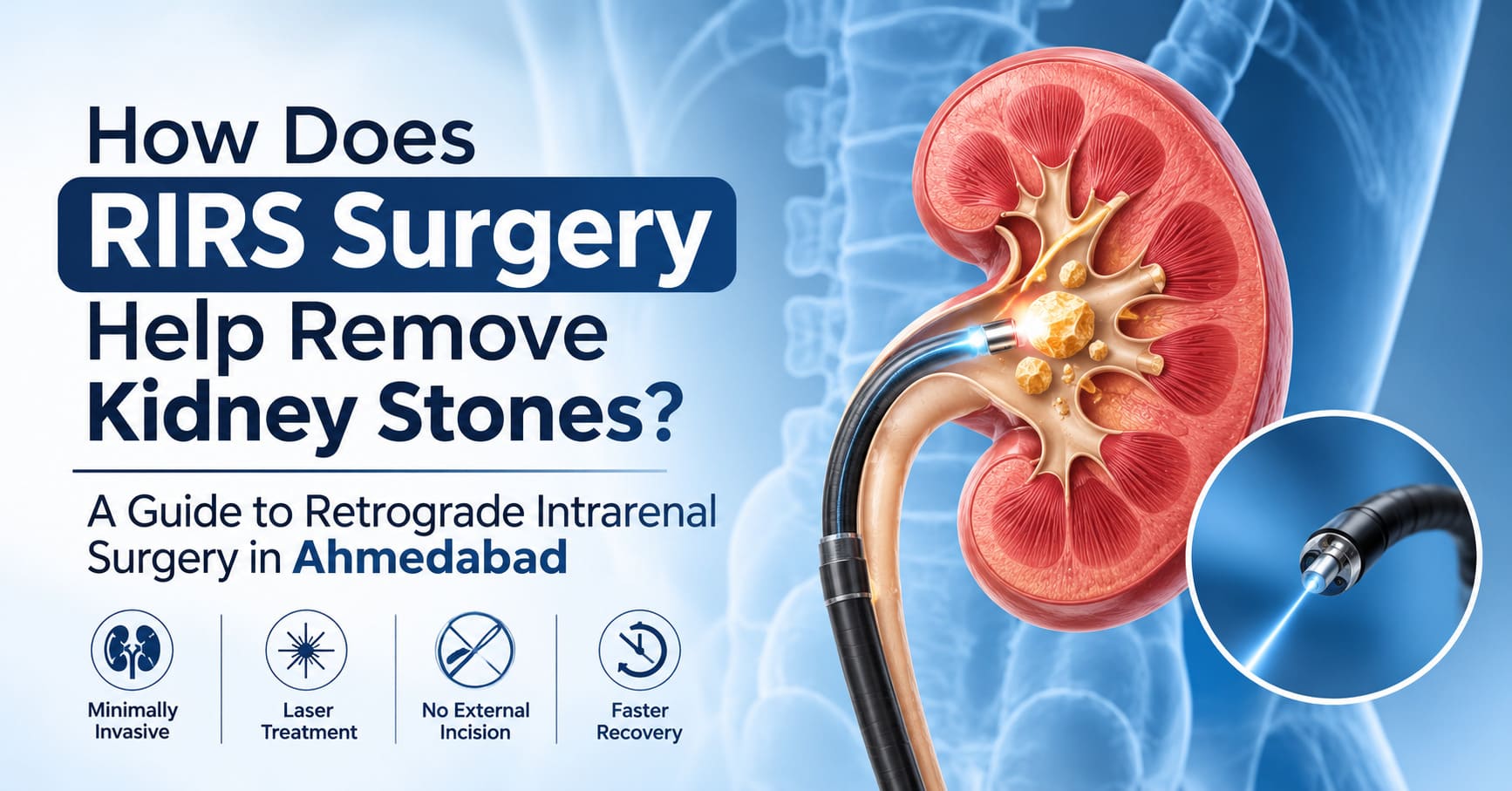
The presence of kidney stones results in sudden pain, difficulty in urination, and a great deal of discomfort. While some stones are either flushed out on their own or treated using some other treatment modalities, there are cases that need an operation for getting rid of stones. There are different surgical techniques for this purpose, one being Retrograde Intrarenal Surgery (RIRS).
For those who are interested in Retrograde Intrarenal Surgery in Ahmedabad, knowledge regarding how this surgery is done, under which condition it is recommended, and how recovery process follows is very useful during the consultation process. Dr. Vineet Ajitsaria, Consultant Urologist, Andrologist & Laparoscopy Surgeon, having over 10 years of experience in urology and andrology, offers consultation for different urological problems.
What is Retrograde Intrarenal Surgery (RIRS)?
RIRS is an abbreviation for Retrograde Intrarenal Surgery, which is a term used to describe a surgical operation that involves the removal of kidney stones without the creation of any cut.
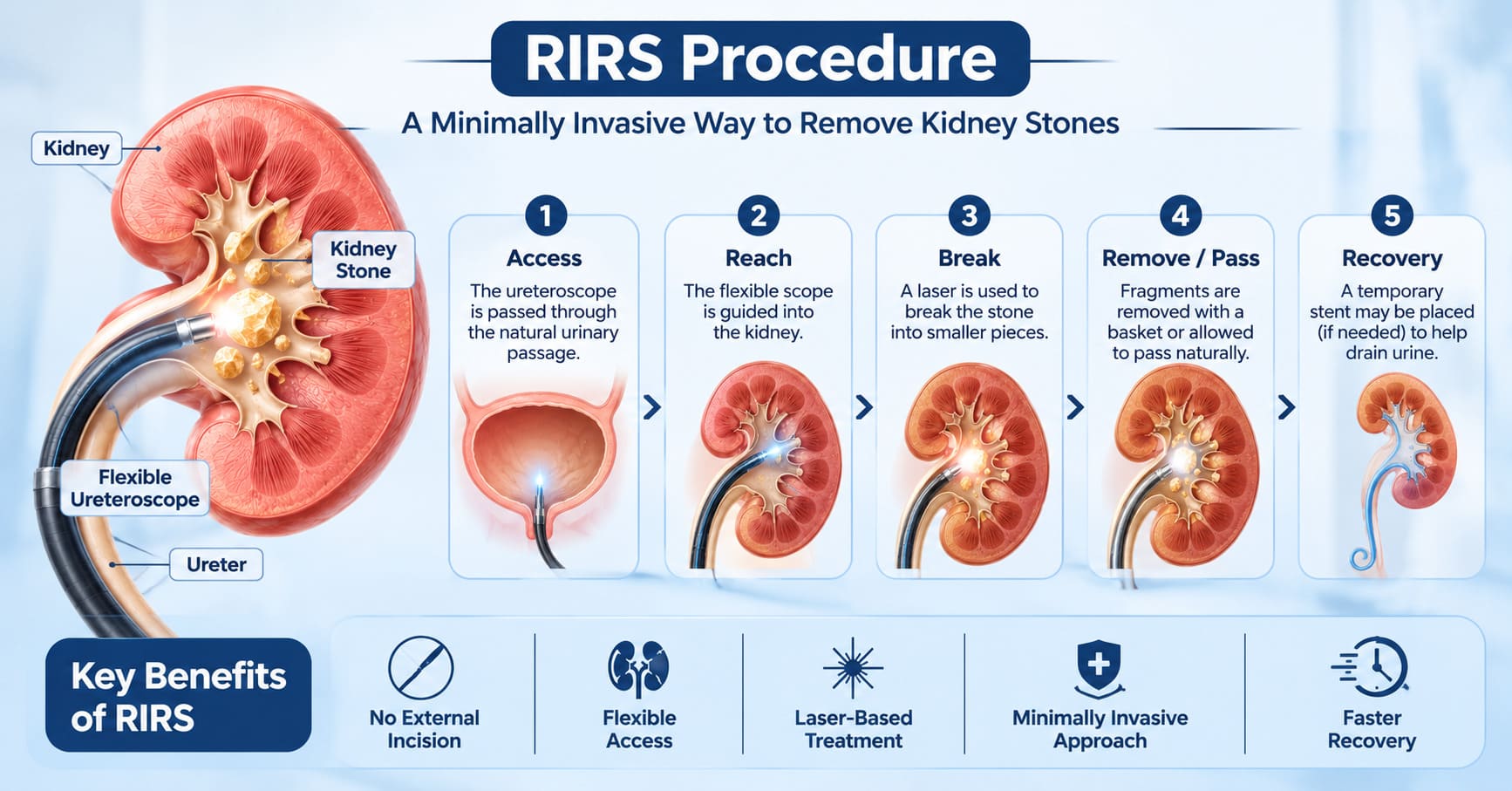
This procedure requires the insertion of a thin flexible tube known as ureteroscope through the urinary tract system:
- Insertion through urethra
- Through the bladder and into the ureter
- Flexible device is then inserted into the kidney in search of stone
- Laser fibre is introduced through the scope to fragment the stone into smaller pieces
- Depending upon the stone and clinical scenario, fragmentation may be taken out through a basket or may pass through urine
As the procedure involves introduction through natural urinary tract, there is no need for any external surgical cut.
Why RIRS Surgery Helps in Removing Kidney Stones?
The principle of RIRS surgery is to reach kidney stones through a flexible endoscope and fragment them through laser energy.
Here is how the procedure usually happens.
Preoperative evaluation
Before suggesting the treatment method, the urologist will perform certain tests on the patient. The test procedures include:
- Performing ultrasound and CT scan to identify the size, number, and position of the stone.
- Testing the urine of the patient to check for infections.
- Performing blood tests to analyze the functioning of kidneys and general well-being.
- Checking medical history of the patient.
These tests help establish if RIRS is a good option for the patient.
Anaesthesia and Scope Insertion
The patient is under general anaesthesia during RIRS procedure. After the patient is ready, the urologist inserts the flexible scope into the urinary tract leading to the kidney.
Laser Fragmentation
The stone localization being done, laser fibers are then applied on the stone to break it into smaller stones. This varies according to the characteristics of the stone.
Management of the Stone Fragments
The urologist may remove certain stone fragments through the use of a retrieval basket depending on the size and position of the fragments. Small stone fragments may be allowed to come out naturally through the urine.
Insertion of a Temporary Ureteral Stent
A temporary DJ stent may be inserted into the kidney to the bladder for draining the urine in certain conditions.
The stent is not needed in all cases and in the event it is used, the physician will indicate when and how it can be removed.
When Should RIRS be Performed on Kidney Stones?
A urologist might consider discussing RIRS in instances such as:
- Presence of kidney stones unlikely to pass on their own.
- Presence of stones in those areas of the kidney which cannot be accessed through other methods.
- Inclusion of selected stones which can be accessed with a flexible ureteroscope.
- Situations in which minimal-invasive endoscopic treatment is deemed to be appropriate.
- Presence of multiple kidney stones in certain patients.
The decision for treatment will depend on various parameters such as stone size, number, location, density, urinary tract anatomy, presence or absence of infection and the overall health of the patient. RIRS is not always the right solution for all kidney stones.
What are the Advantages of RIRS?
For properly selected patients, RIRS can provide some benefits:
- Absence of the incision on the skin surface: The surgery is performed via natural body channel.
- Versatility: Ureteroscope can be directed at different regions inside the kidneys.
- Use of laser: Laser energy helps to fragment the stone.
- Less invasive technique: It eliminates any cuts on the body surface.
- Customised treatment: This procedure can be planned according to the nature of the stone and the patient's health condition.
But there are some disadvantages of the technique too. Some stones require repeated procedures, and in some cases, other methods are better to use.
RIRS vs Other Kidney Stone Treatment Options
Different kidney stone treatments are used depending on the patient's diagnosis. The following comparison provides a general overview.
|
Treatment |
How It Works |
When It May Be Considered |
|
RIRS |
A flexible scope reaches the kidney through the urinary passage, and a laser breaks the stone |
Selected kidney stones based on size, location, and anatomy |
|
ESWL |
Shock waves are used from outside the body to break stones |
Suitable stones that can be targeted effectively |
|
PCNL |
A small surgical tract is created through the back to reach and remove stones |
Often considered for larger or complex kidney stones |
|
URS |
A ureteroscope is used to access and treat stones in the ureter |
Selected kidney stones based on size, location, and anatomy |
Each procedure has its own benefits, limitations, and risks. A urologist can recommend the appropriate option after reviewing the patient's reports.
What is the Time Needed for Recovery Post-RIRS?
Recovery after RIRS highly varies from one individual to another. Some individuals are capable of returning to their routine after a few days; however, this also varies depending on their general condition and the decision of their surgeon.
After the operation, there may be a few side effects that might arise including:
- Burning or pain during urination.
- Blood in the urine.
- Urgency and frequency of urination.
- Lower abdominal pain or pain in the back region if the DJ stent was placed.
Such side effects can be either due to the surgery or because of the placement of the stent.
Precautions After RIRS
The post-surgery precautions will depend on the recovery of the patient and will be provided to you by your urologist. They include:
- Consumption of fluids as directed by your doctor.
- Taking medications as prescribed by your doctor.
- Avoiding physical activities until approved by the doctor.
- Having follow-ups.
- Removing the temporary DJ stent.
Please notify your healthcare provider in case of fever, shivers, pain, difficulty urinating, or excessive bleeding. The fever after a urinary procedure can be a sign of infection.
Are There Any Risks Associated With RIRS?
EveAlthough it is an invasive procedure, RIRS may have some complications, which include:
- UTIs.
- Hematuria.
- Inflammation or damage to the ureter.
- Irritation resulting from the introduction of the DJ stent.
- Residual stone fragments.
- A need for another procedure due to incomplete stone removal.
The probability of developing these complications will depend on the patient’s health, stones' features, and procedure outcomes. It is advised that you should talk about them with your urologist beforehand.
How to Choose a RIRS Specialist in Ahmedabad?
The choice of a well-trained specialist is a key point for planning the treatment of kidney stones. Here are some issues that should be considered:
- Qualification of the urologist.
- Experience in performing urological endoscopy of kidney stone removal.
- Study of stone parameters – size, localization, complexity.
- Information on possible treatment methods.
- Recommendations for recovery period.
If you are looking for a RIRS Surgeon in Ahmedabad, discuss your scan reports and issues related to the treatment during the consultation process. The right choice of procedure must be made through proper clinical evaluation and not by just seeing the name of the treatment method.
Reasons for consulting Dr. Vineet Ajitsaria
Dr. Vineet Ajitsaria is a Consultant Urologist, Andrologist & Laparoscopy Surgeon in Ahmedabad having more than 10 years of experience in urology and andrology.
His services include treatment for kidney stones and other diseases of urology. The patients can consult with Dr. Vineet about their problems, reports, and treatments.
If you are thinking of having Retrograde Intrarenal Surgery in Ahmedabad, the individual evaluation will give you an idea of whether RIRS surgery is suitable for you or not.
FAQs
1. Is RIRS surgery painful?
Generally, the RIRS procedure is done under general anaesthesia, hence the patient won't be feeling any pain while undergoing the surgery.
2. How long does RIRS surgery last?
This will depend upon the size, number, and location of the stones, and the complexity of the surgery. Your urologist will give you the approximate time based upon your reports.
3. Does RIRS get rid of all kidney stones at once?
No, sometimes it cannot. Sometimes multiple sessions are needed for removing the stones because some stones are big, many in number, or cannot be accessed easily.
4. Is a DJ stent essential post-RIRS?
A DJ stent is not compulsory for everyone. This stent is placed only if there is a need as determined by your urologist for draining out urine from your kidney.
5. When will I be able to return to my regular activities post-RIRS?
The time taken by an individual to recover and return to his normal activities differs from person to person. However, most people are able to return within a few days post-RIRS.
6. Is RIRS superior to PCNL or ESWL?
There is no one solution that is effective in all circumstances. Depending upon the nature of stone and health condition of the patient, either of RIRS, PCNL, or ESWL can be suggested by the urologist.
Need Guidance for Kidney Stone Treatment?
If you are looking forward to getting Retrograde Intrarenal Surgery in Ahmedabad, you should consult Dr. Vineet Ajitsaria for an evaluation of your kidney stone condition and guidance on suitable treatment options, including RIRS.

Dr. Vineet Ajitsaria
Dr. Vineet Ajitsaria is a renowned Consultant Urologist and Andrologist with more than 10 years of clinical experience. He completed his medical education at the prestigious B. J. Medical College and Civil Hospital, Ahmedabad. His areas of expertise include the evaluation and treatment of complex urological conditions, endourological procedures, reconstructive and laparoscopic urology, and urological cancers.